
April 20 to 24th, 2026
Greenville is a beautiful city, we thoroughly enjoyed a four-night break in April.
It’s about a 5-hour drive from Hilton Head to Greenville. The city is located in the north and west of South Carolina, in the foothills of the Appalachians. The drive was on Interstates, and both were very busy. Given the amount of construction on I-26, we can see why there is apparently little money available for desperately needed widening of I-95!
We stayed at an all-suites hotel. At least, that’s what they called it. In Spring Hill Suites, the room, although very large, has no dividing walls and is essentially a standard hotel room with a large sofa bed at one end.
Dinner the first evening was at a nearby Belgian restaurant, The Trappe Door. We had hoped to have a drink first at the hotel, but their restaurant/bar is closed on Mondays, and the Trappe Door didn’t unlock their doors until 5pm exactly, the time of our reservation. Initial impressions were not entirely positive. The restaurant was incredibly dark; I needed to use the flashlight on my phone to read the menu. Rap music (huh??) was playing so loudly that I could not hear the waitress standing right beside me. I was not alone, the waitress said she would turn it down when I asked her, but before she even left the table, somebody else took care of it. The place was still very noisy as it filled up with diners.
Dick started with bitterballen, deep fried beef and cheese croquettes, served with spicy mustard. His first bite was perhaps a little disconcerting, as he mistook the mustard for a dip and dipped a large quantity onto the meatball. Subsequent bites were a big improvement. My choice was wild mushrooms served in a vol au vent; it was delicious. The main courses were very good, and we shared a lemon crepe for dessert.
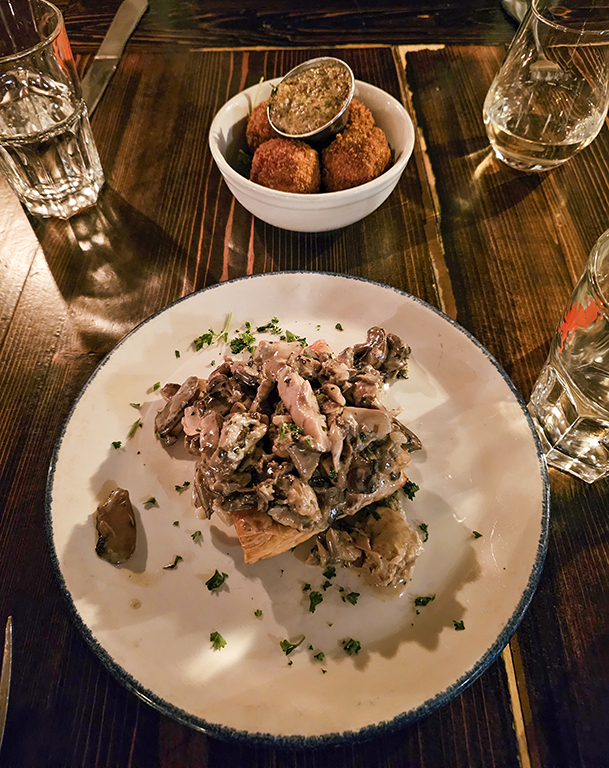
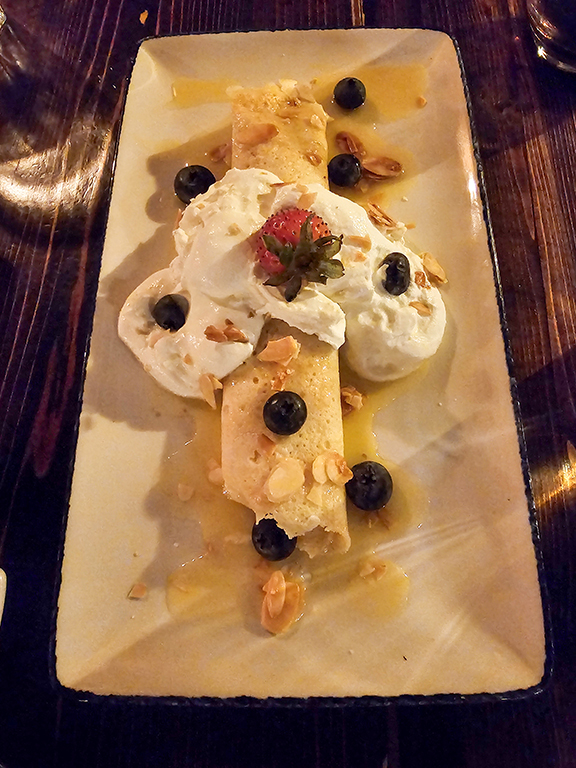
By the time we were finished, the restaurant was full, and the noise was incredible. I enjoyed the food but would be unlikely to return. Dick loved it, especially as the food reminded him of the best of Dutch specialties.
Our planned Segway tour for Tuesday was cancelled on Monday afternoon. After major renovation of their building, all the tenants were given rent increases that were unsustainable for a small business. It was disappointing, because we love Segway tours, but on the other hand, Dick had planned a lot of activities for Tuesday, so it was probably just as well.
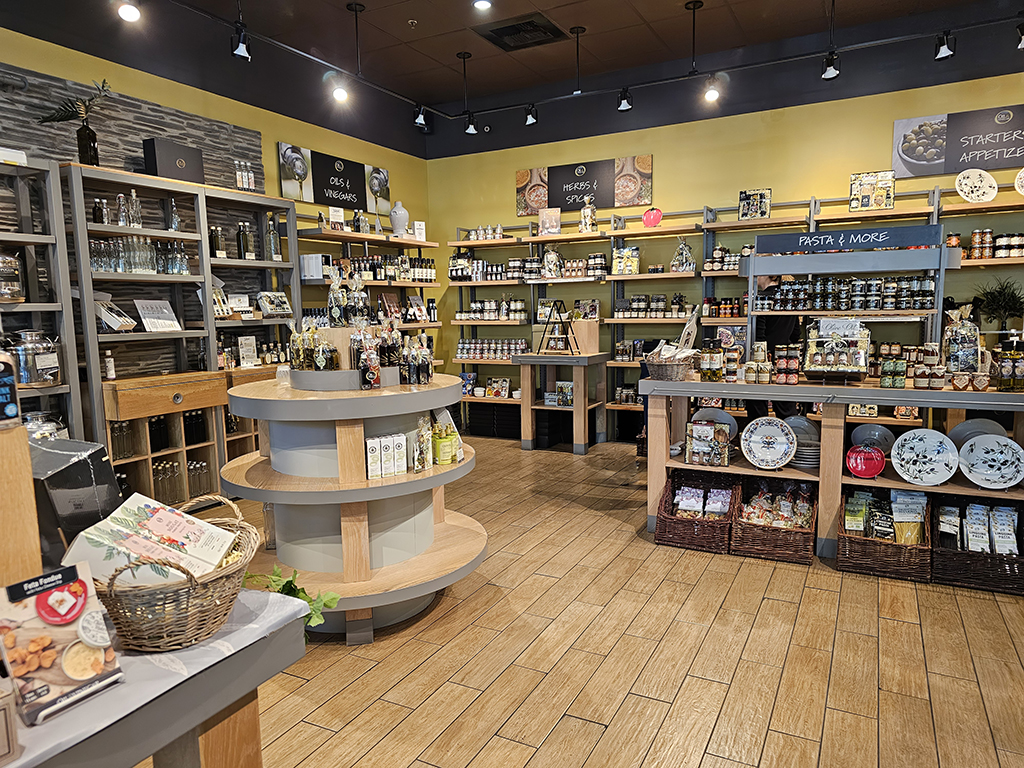
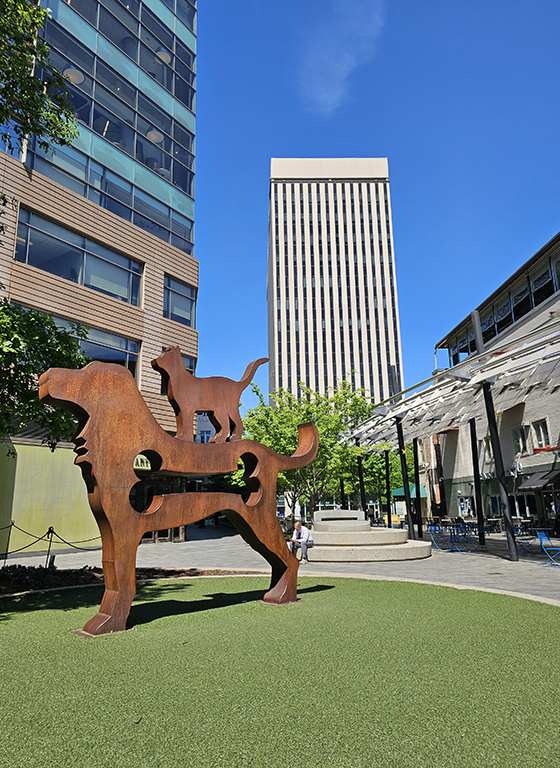
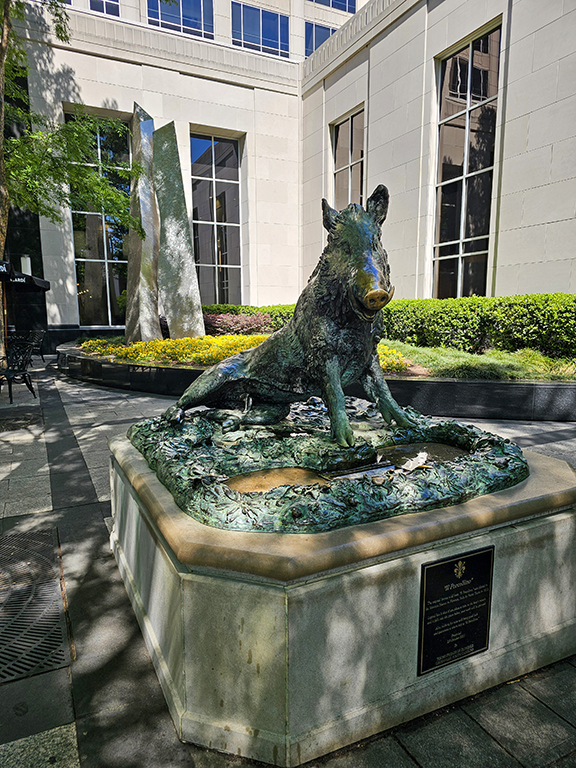
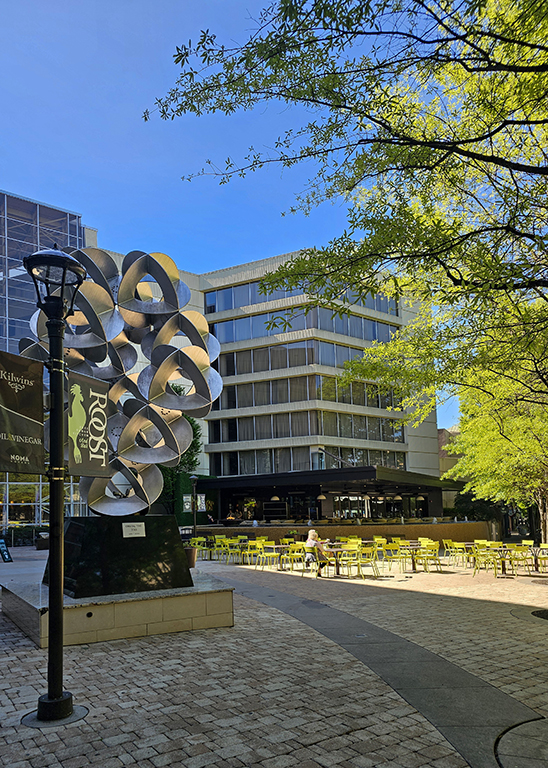
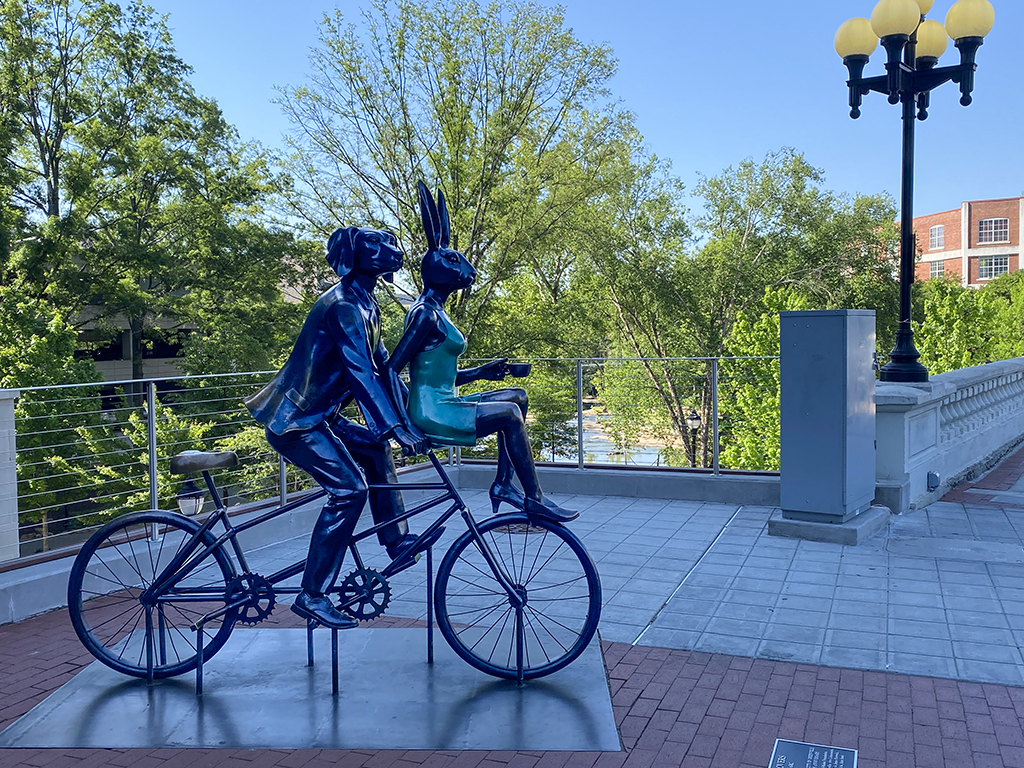
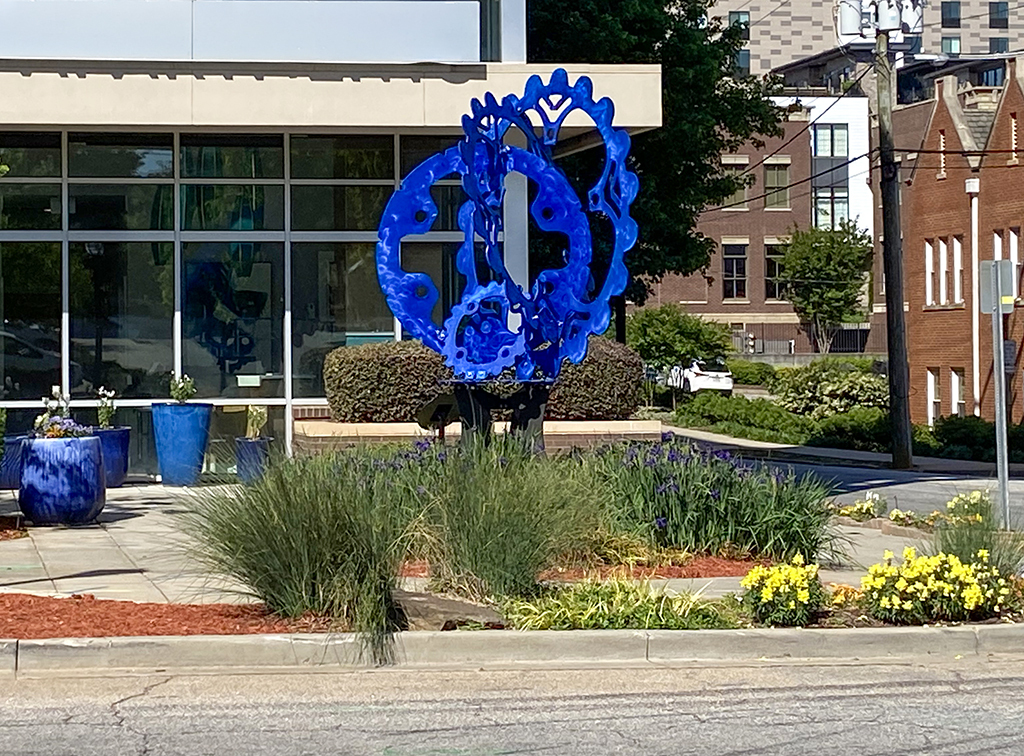
Tuesday morning, we set off around 10am towards the district that features independent boutiques (and lots of restaurants). A shop selling olive oils, vinegars, and a variety of interesting foodie items was a rewarding first stop. Later, we found a nice leather shop, and both of us came out with small treasures. Other places looked interesting, but it was time to make our way slowly towards Falls Park on the Reedy, stopping to admire some of the interesting sculptures and lovely buildings.
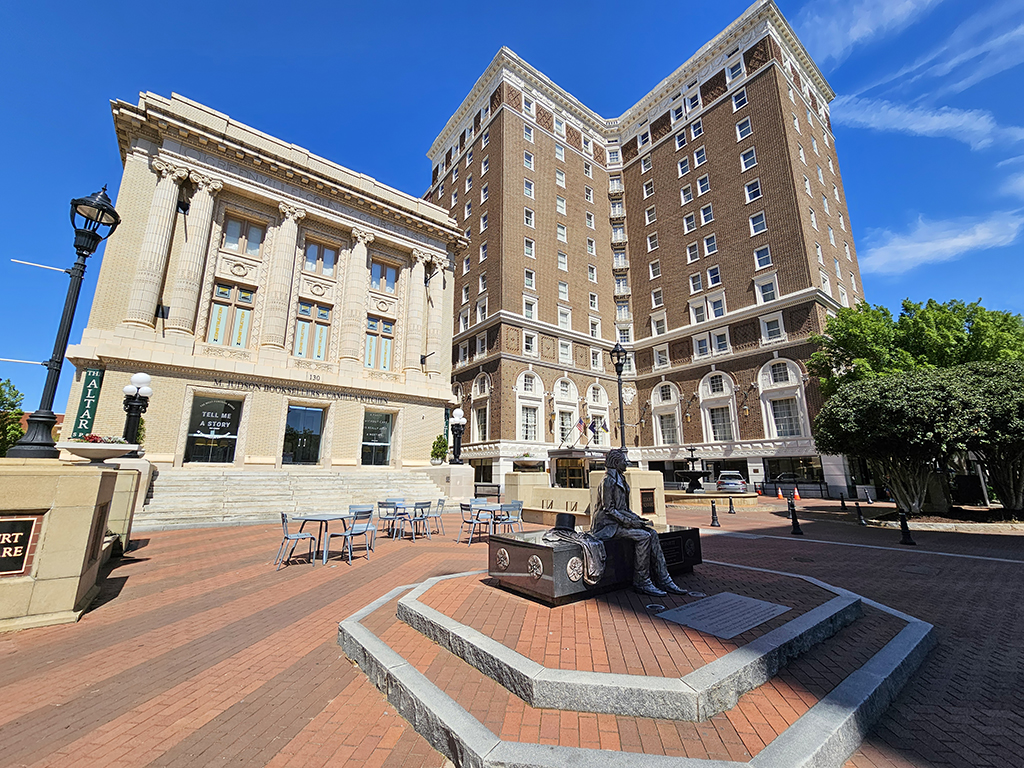
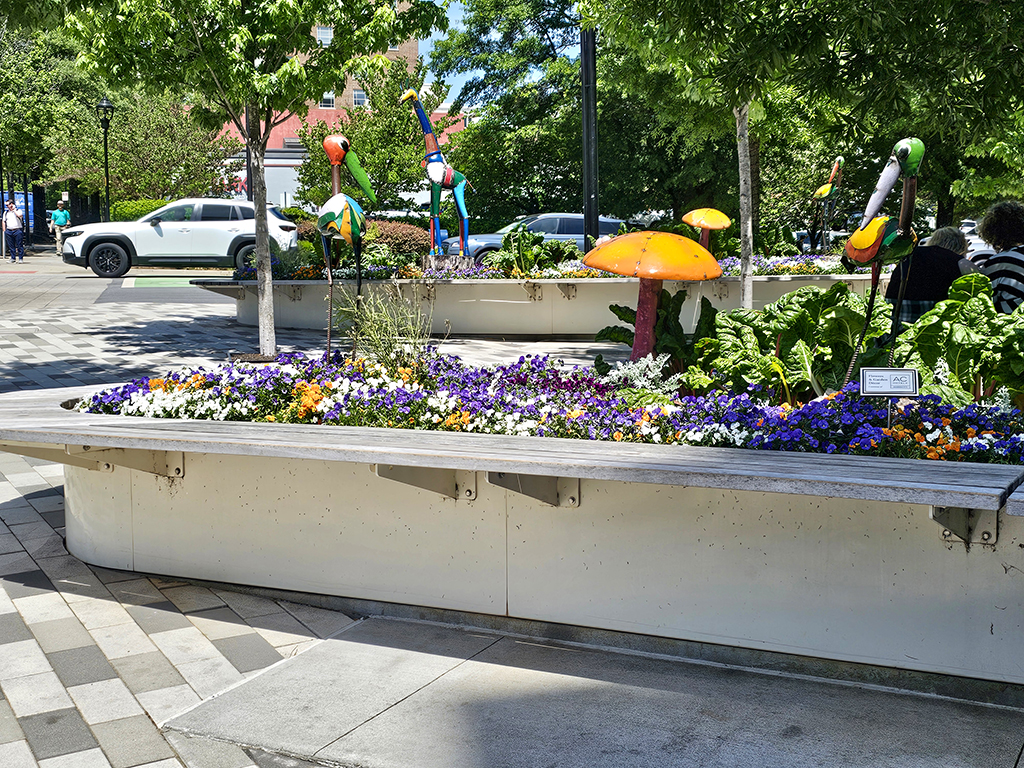
Greenville is a very clean and tidy city, with lots of leafy squares and interesting buildings, both historic and modern. Statues and historic plaques tell passers-by about the history and the movers and shakers of the city’s story.
In Court Square, a statue of Joel Poinsett commemorates the scholar, diplomat, and botanist who is credited with introducing the poinsettia to the United States from Mexico. The beautiful former courthouse building now houses a bookshop, and at the other side of the square, the Westin Hotel occupies a historic building. Later we visited for breakfast, and it was lovely to see that the beautiful interiors have been left untouched and are still a window on past, more elegant times.
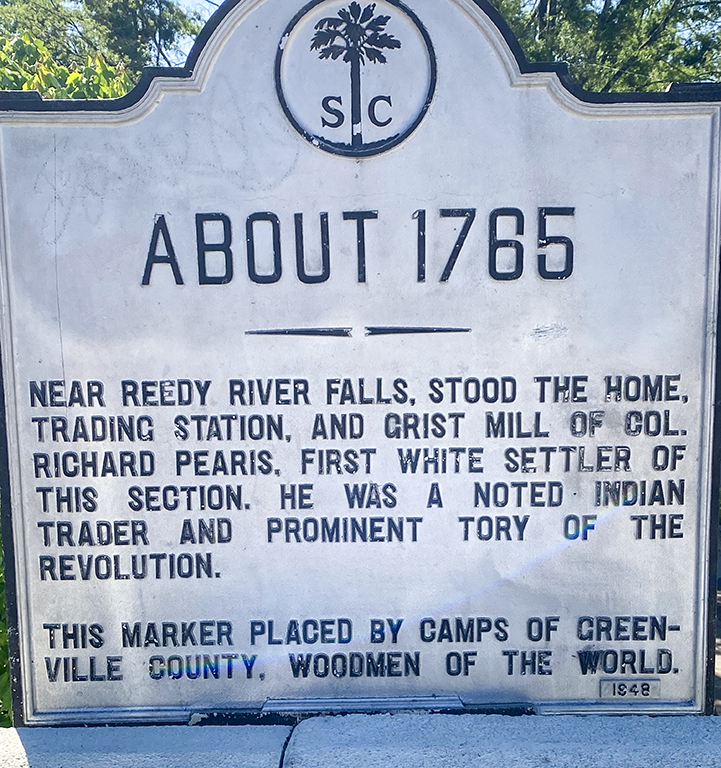
The story of Greenville began in about 1754, when Richard Pearis arrived in South Carolina with his wife and three children. The area that now includes Greenville was the hunting ground of the Cherokee, and was forbidden to colonists. Born in Ireland, Richard grew up in the Shenandoah Valley, and by the time he was an adult, he had acquired land and was trading with the local Cherokee. Eventually, he expanded his business to include Cherokee from South Carolina. Despite being married with three children, he fathered a son by a Cherokee woman. He and another member of the colonial gentry forged letters from Cherokee leaders, claiming that they were willing to cede land to Virginia. Using the letters, he obtained a land grant from one of the Cherokee leaders, but was caught by the British Indian Superintendent, and prosecuted. In the meantime, he had transferred much of the land to other settlers, so the land he surrendered on conviction was less than he had originally acquired. Next, he convinced the chiefs to give land to his part Cherokee son George, who immediately transferred the ownership to his father. Richard and his family, plus their slaves, cleared land in what is now Greenville, and planted crops, built a house and store, and a grist mill and a sawmill. He was active in the French and Indian War, and again on the side of loyalists during the American Revolution. Eventually, his property was burned and crops destroyed by rebels, and he ended his days as a planter in the Bahamas, having been compensated for the loss of the land in Greenville by the British government. (that would be the land he was not supposed to have owned in the first place). There is a plaque in one of Greenville’s squares with an abbreviated story that credits him with founding the city (and does not mention any of his fraudulent activities).
By the start of the American Revolution, the Cherokee were beginning to feel both cheated and threatened by the various treaties that they had signed to cede land in payment of debts to white settlers. They began attacking colonial settlements. Their attacks resulted in an expedition with a large force of Continental Army troops and militia, who destroyed Indian villages and crops and broke their regional power for good. The Treaty of Dewitt’s Corner was signed, and the Cherokee lost most of their land in South Carolina.
Greenville County was formed in 1786, and by 1787 the village of Pleasantburg was established. It was renamed Greenville in 1821. Following the Civil War, Greenville became a centre for cotton mills and textile manufacture, eventually being known as the “Textile Center of the South.” The establishment of rail infrastructure to support the textile businesses, ensured that Greenville was a major manufacturing hub. The textile business has mostly gone, but the city is still a centre for advanced manufacturing and automotive production.
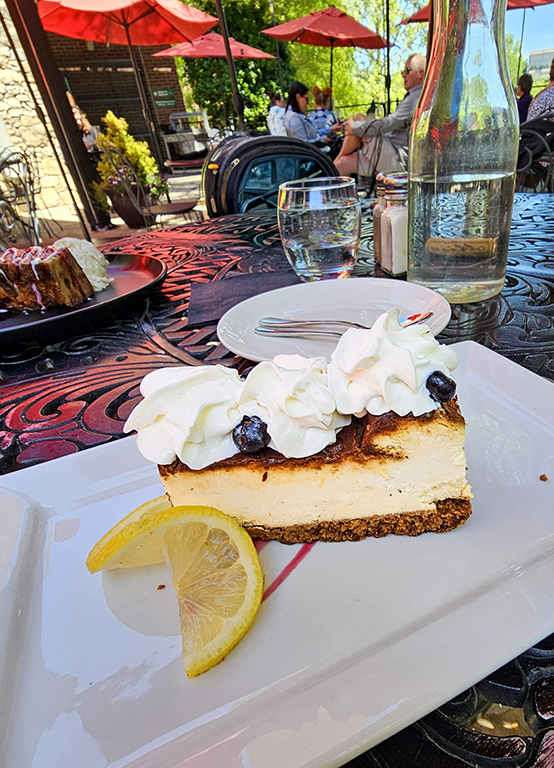
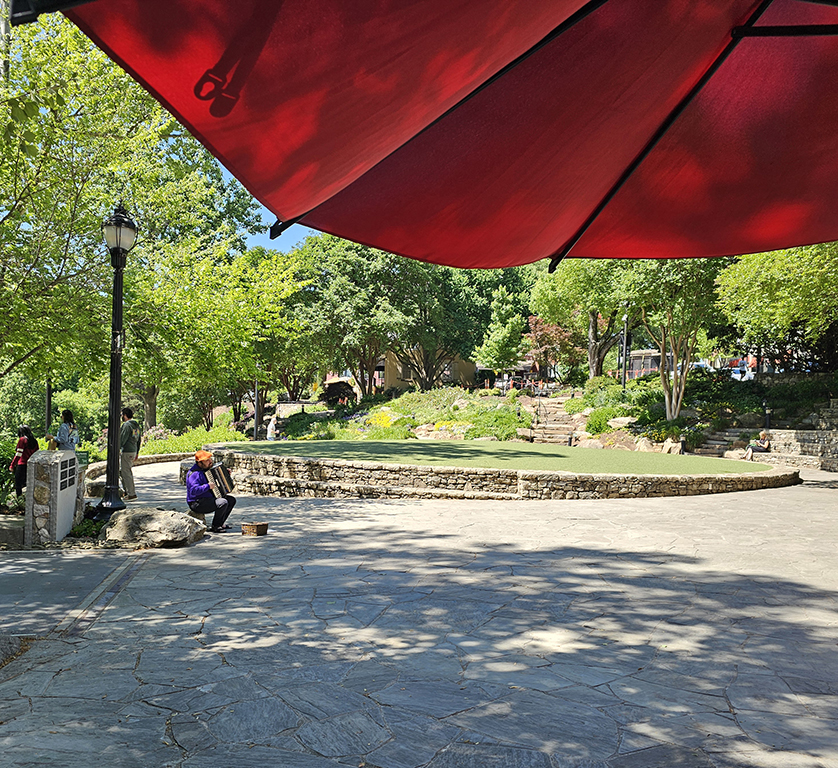
Passerelle, a French bistro, overlooks Falls Park on the Reedy, and has more outside than indoor seating. It was a little chilly in the shade, but the compensation was listening to a nearby busker with an accordion playing (mostly) French music. The beautiful red umbrellas that cover the patio seating are evocative of a typical European outdoor venue.
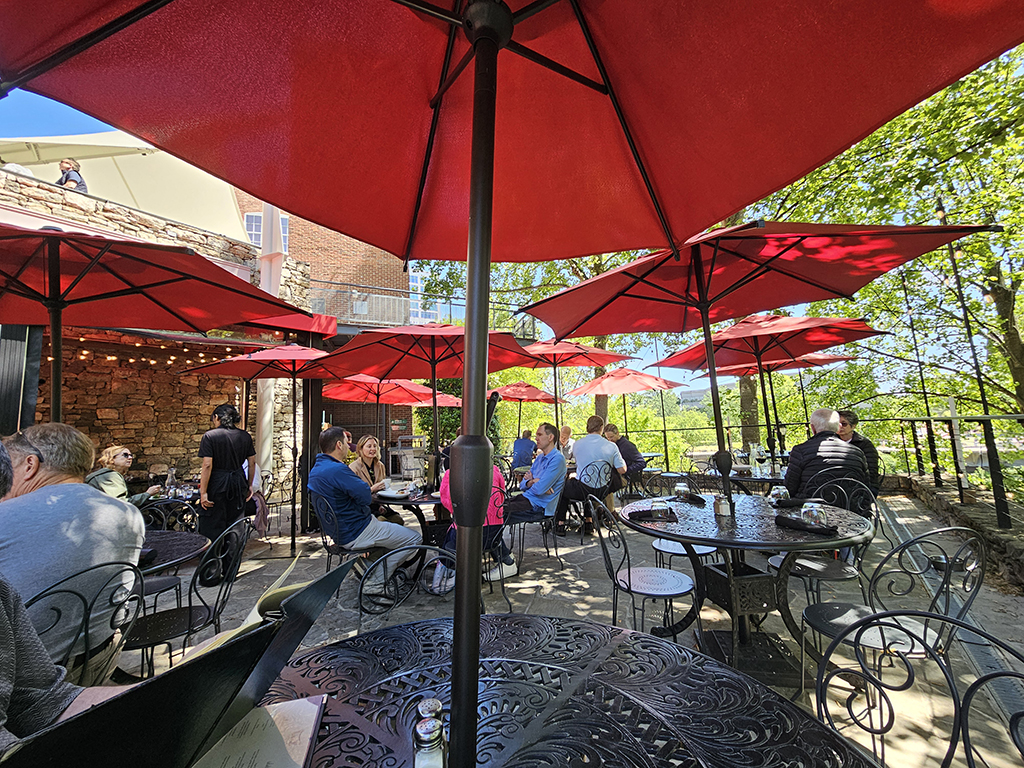
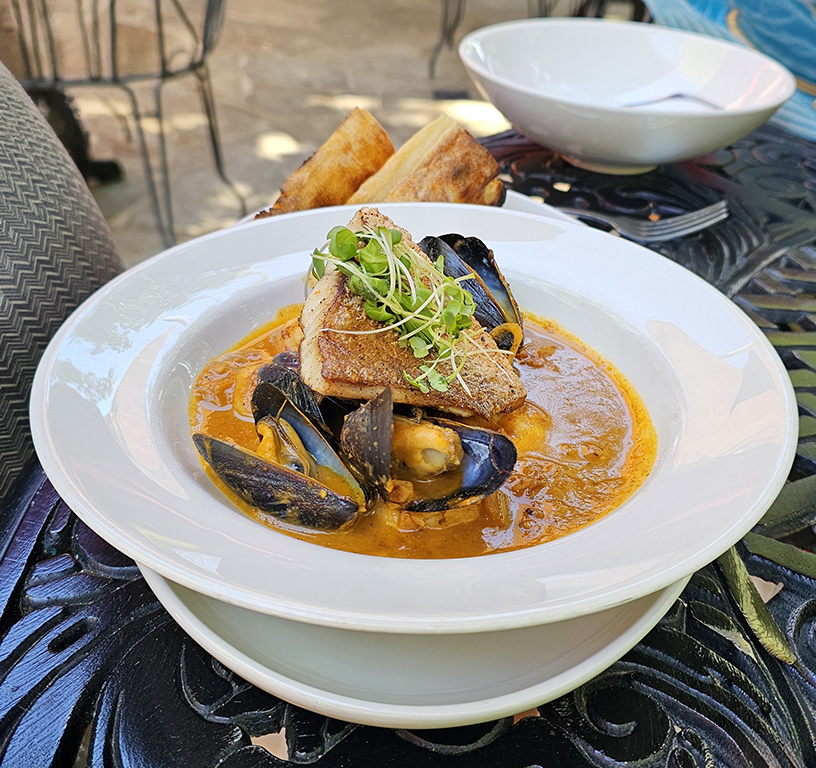
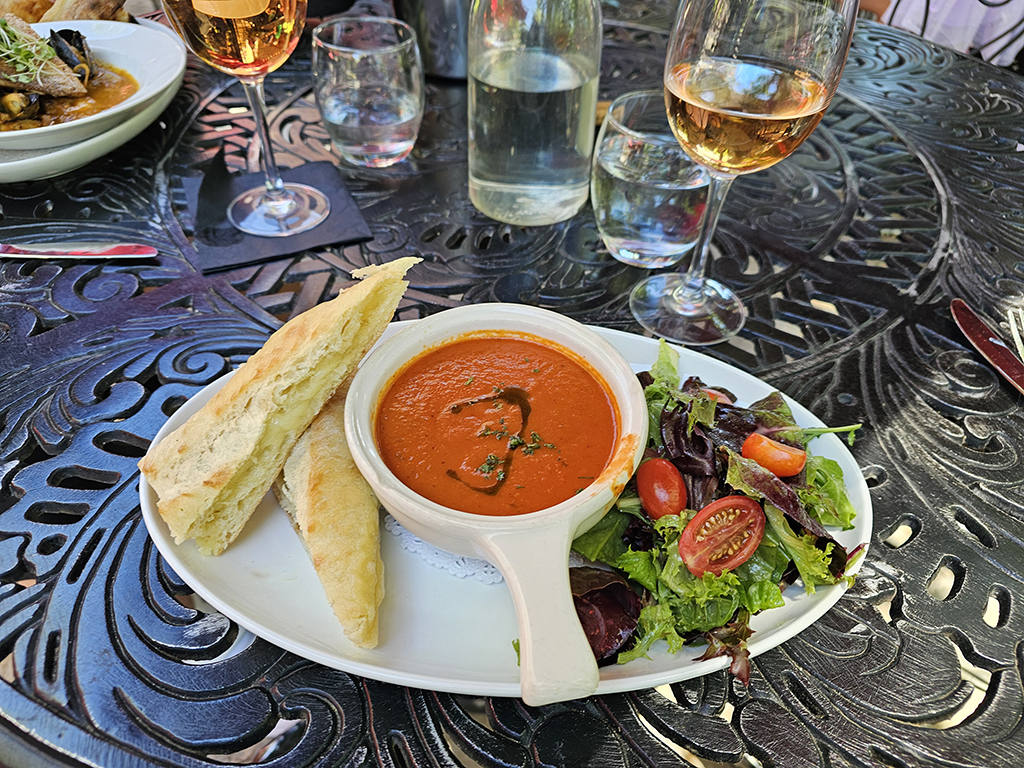
Some of the food was quite authentic, some rather less so. Dick’s onion soup was served the American way (which we both prefer) with loads of cheese, and it was delicious. My truffle fries with garlic aioli were also excellent, even though they were merely warm instead of piping hot. The bouillabaisse was very good, and mostly Normandy style, although the rouille was spread on the toast instead of being served separately to stir into the soup. I ordered Bistro Grilled Cheese and Tomato Fondue, falling into the trap of thinking it would be a cheese and tomato fondue. Instead, it was a grilled cheese sandwich with a thick tomato soup. A very American comfort food dish, with a French twist. It’s just not something that I grew up with or was expecting. It was very tasty, but, as is usual in this country, it was merely warm and would have been better served hot.
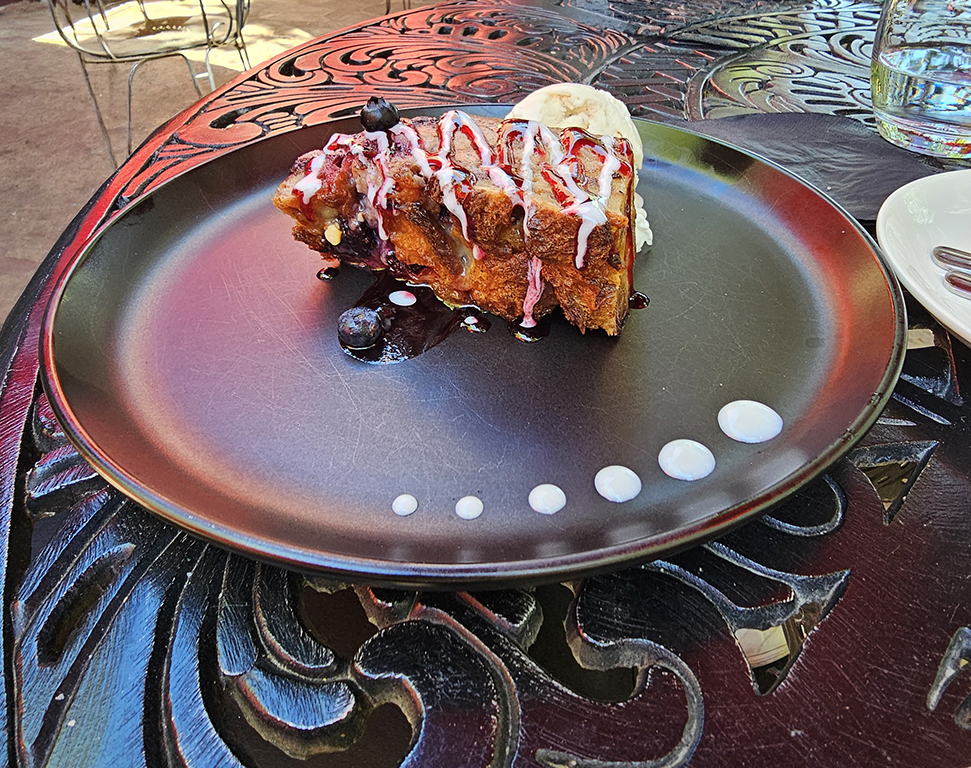
Desserts were a mixed bag. Dick’s croissant bread pudding was very nice, while my lemon cheesecake was an overly dry European style, so not to my taste. When the waitress walked over to ask if the desserts were all right, she saw Dick had finished all of his, and commented, “there’s a hole in your plate!”
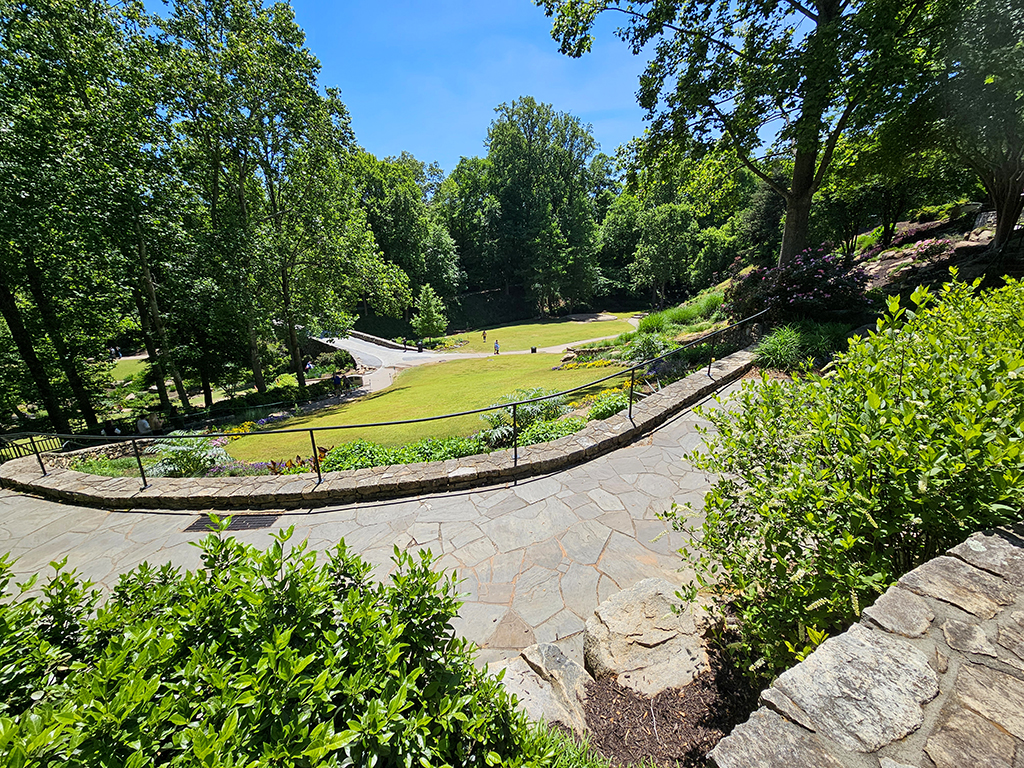
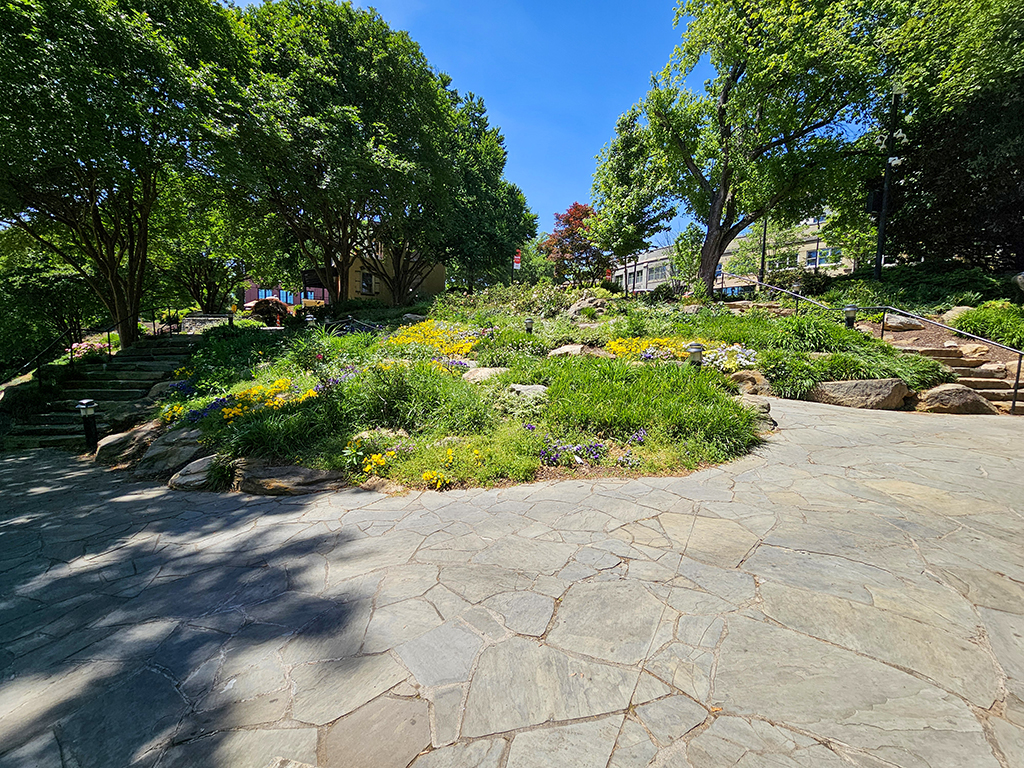
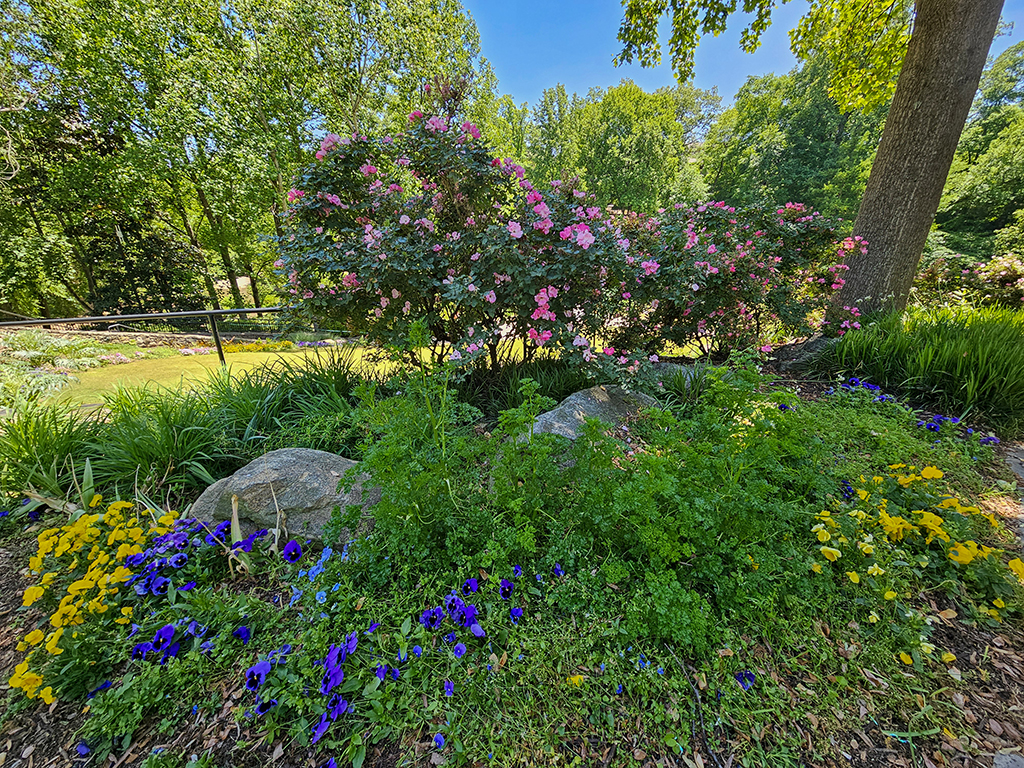
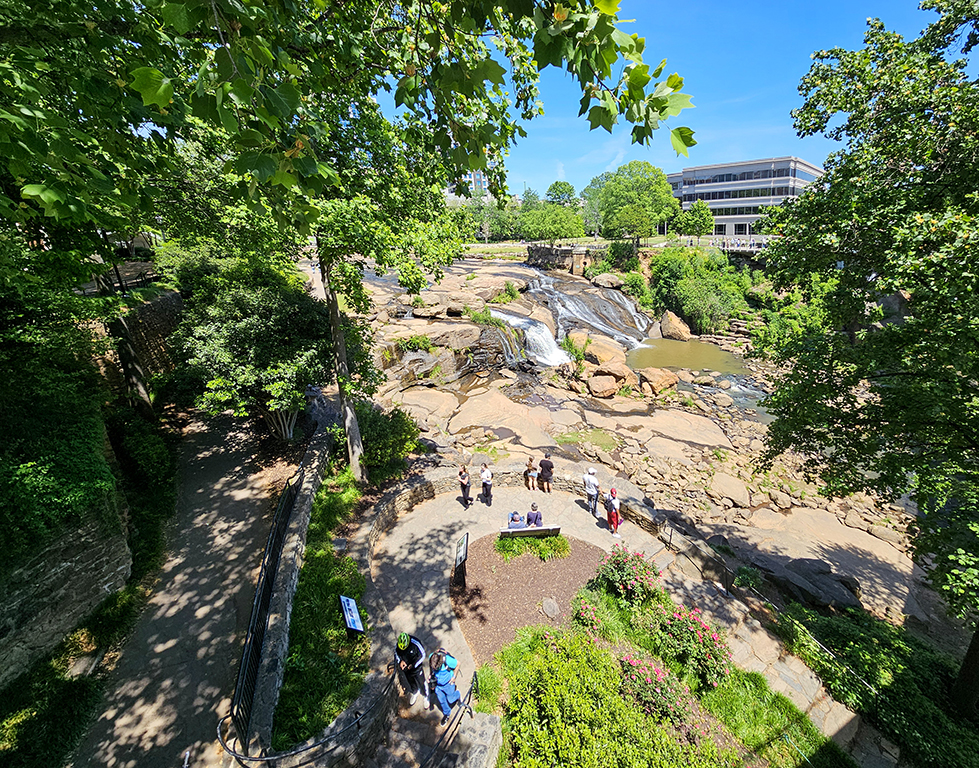
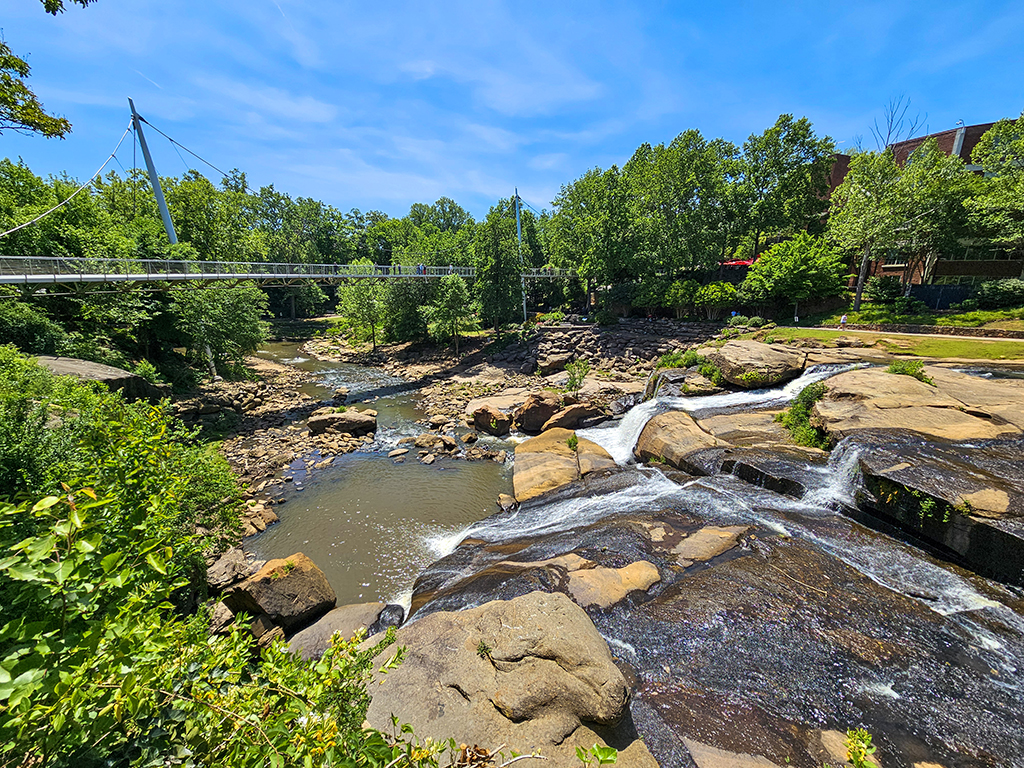
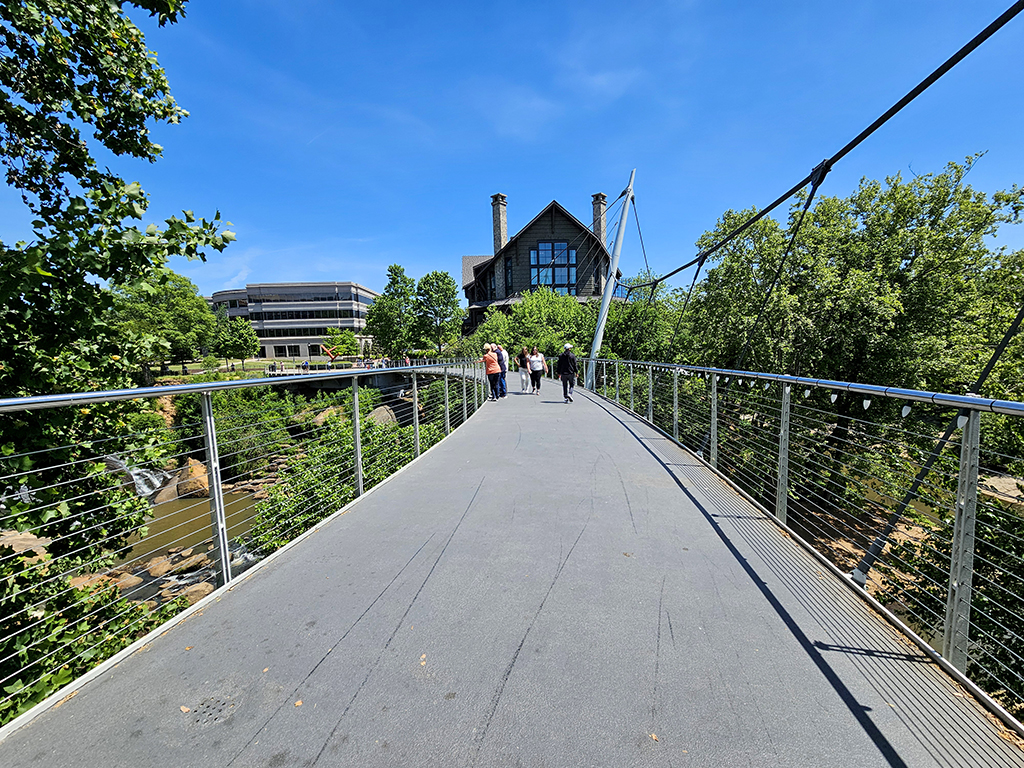
The Reedy River in downtown Greenville was the site of trading posts, grist and corn mills, a sawmill, an ironworks, a coach factory, a paper mill, and an armoury. Eventually textile mills replaced the earlier industries, discharging their waste and excess dyes into the river. By the mid-20th century, the river was so polluted that it had become unsafe and desolate. Falls Park on the Reedy was created in 1967 by the Carolina Foothills Garden Club. 26 acres of land that had been occupied by the former textile mills was reclaimed and the gardens were established. Eventually the six-lane highway bridge that had crossed the river was demolished. In addition to being unsightly, it was a hangout for criminals and undesirables. In 2004 the beautiful 355-foot-long curvilinear suspension bridge was built for pedestrians to cross the falls. It was initially named Reedy Falls Bridge, but before it opened, a donation of $3 million ensured that the bridge was named The Liberty Bridge, after the media and insurance company. It is the only suspension bridge of its kind in the United States.
Greenville is the original home of Duke’s Mayonnaise, a favourite product of the American South. Eugenia Thomas Slade Duke was born in 1881 and moved to Greenville in 1917 with her husband and daughter. During WWI, she started making sandwiches to offer a taste of home to soldiers training at a nearby base. Duke Sandwich Company continued to grow after the end of the war, requiring new premises and the opening of Duke’s Tea Room in a former hotel. By 1925, Eugenia started producing her distinctive mayonnaise in a converted factory building that had formerly been the paint shop for a coach factory. The Duke Sandwich Company, and Duke’s Mayonnaise are still a thriving business under the third generation of Eugenia’s family.
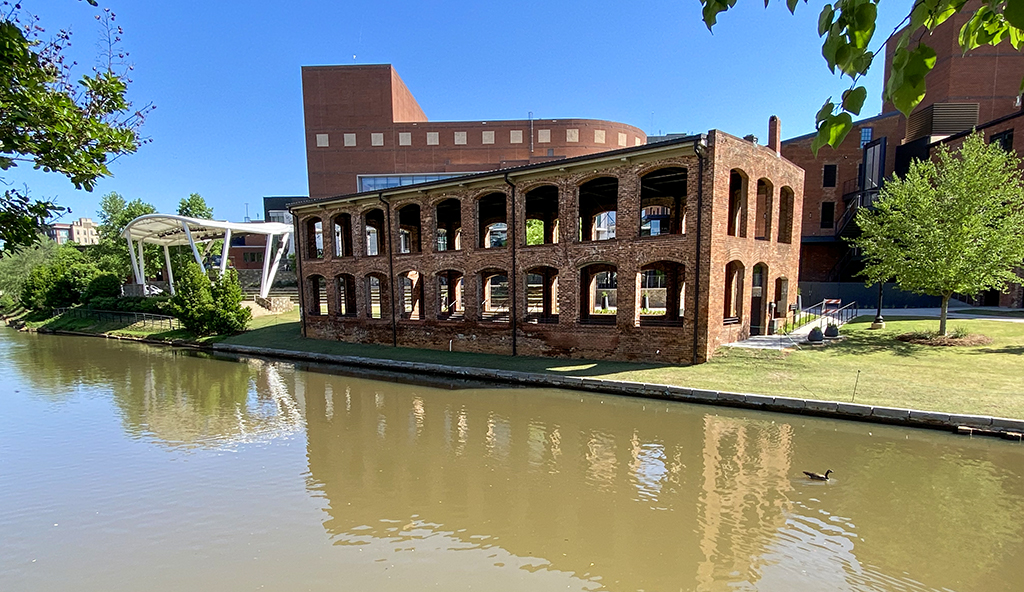
After a short exploration of beautiful Falls Park, we wandered back to the hotel and had time for a good rest before heading out for the evening. It was a relatively short walk to the arena where we had tickets for Stars on Ice.
12 recent American Olympic and World Championship team members and medal winners put on an excellent show. It was very nice to see Madison Chock and Evan Bates, the ice dance pair that we so enjoyed when we watched them on TV in February, perform their Olympic routine live. The group routines were not quite as well executed – individuals and pairs who are used to performing alone are not so good at synchronized routines, no matter how well choreographed, and they had only 6 weeks of practice before taking the show on the road. We enjoyed the show. The audience, we did not enjoy so much. It is apparently necessary to shriek Wahhh!! at every interesting moment during every routine, plus even more at the end while the skaters take their bows. Unfortunately, I was sandwiched between Dick, who is not a small man, and a very large young woman. As a person who would probably rather not be touched, being stuck between two very large, warm people, is not ideal! Not to mention the piercing voice and frequent bouncing up and down by my neighbour on my right (not Dick, who was suitably quiet, and who I do not mind too much being cuddled up to!)
I grew up in Toronto, and as a teenager, I spent a lot of time, along with my parents, learning ice dancing at the Toronto Cricket, Skating and Curling Club. The club has produced many Canadian skating champions over its long history, and I remember spending time in the dressing room with aspiring young women whose whole focus in life was skating competition. These teenagers spent all their time at the club, skipping homework, and often school, in pursuit of their (or just as often their mother’s) ambitions. Only a very few are successful, and that success is very short. Once they age out of competition, there is a brief opportunity for skating shows, after that the options are reduced to teaching, or occasionally, broadcasting. Their education is inadequate, and they have no marketable skills that will allow a transition to the normal workforce. I enjoy watching figure skating, but I cannot forget how much sacrifice, effort and dedication is required for success, and how little there is to show for it at a time when the skaters could be enjoying their peak earning years in a traditional profession.

We walked back from the arena after the performance and enjoyed the large nightcap that we had sadly missed the previous night when the hotel bar was closed.
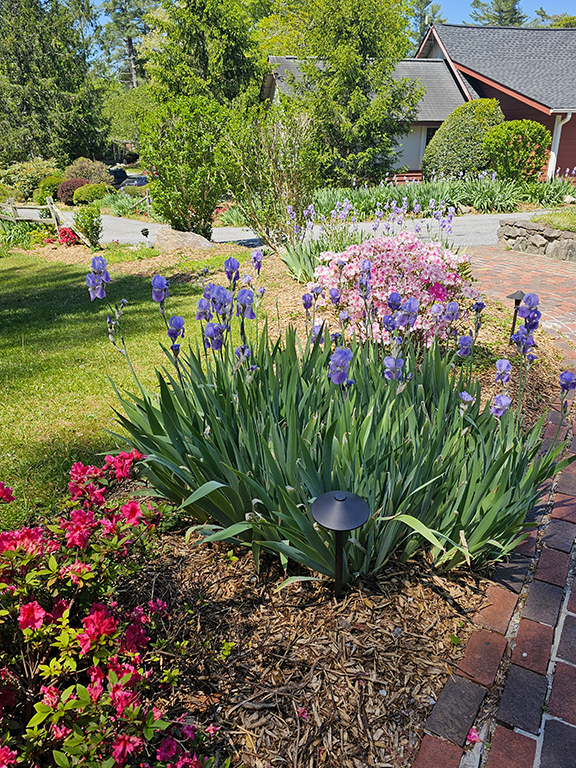
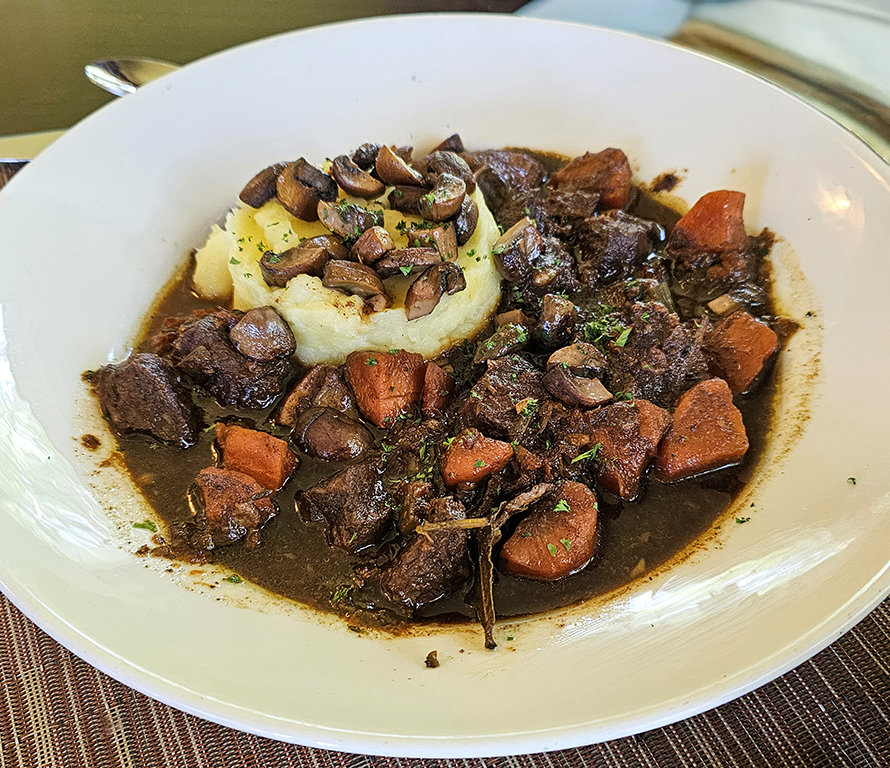
On Wednesday, after a quiet morning, we drove to Hendersonville, North Carolina, to have lunch with friends at a resort in the foothills. We were very surprised to be greeted by the restaurant manager, who was once our favourite waitress when she worked at Wexford some years ago. She had seen our name in the reservation book and was excited to say hello. The resort is a beautifully kept, old fashioned country inn with individual cabins. There are lovely gardens surrounding the buildings, and a nearby lake is on the property. The restaurant served a nice lunch.
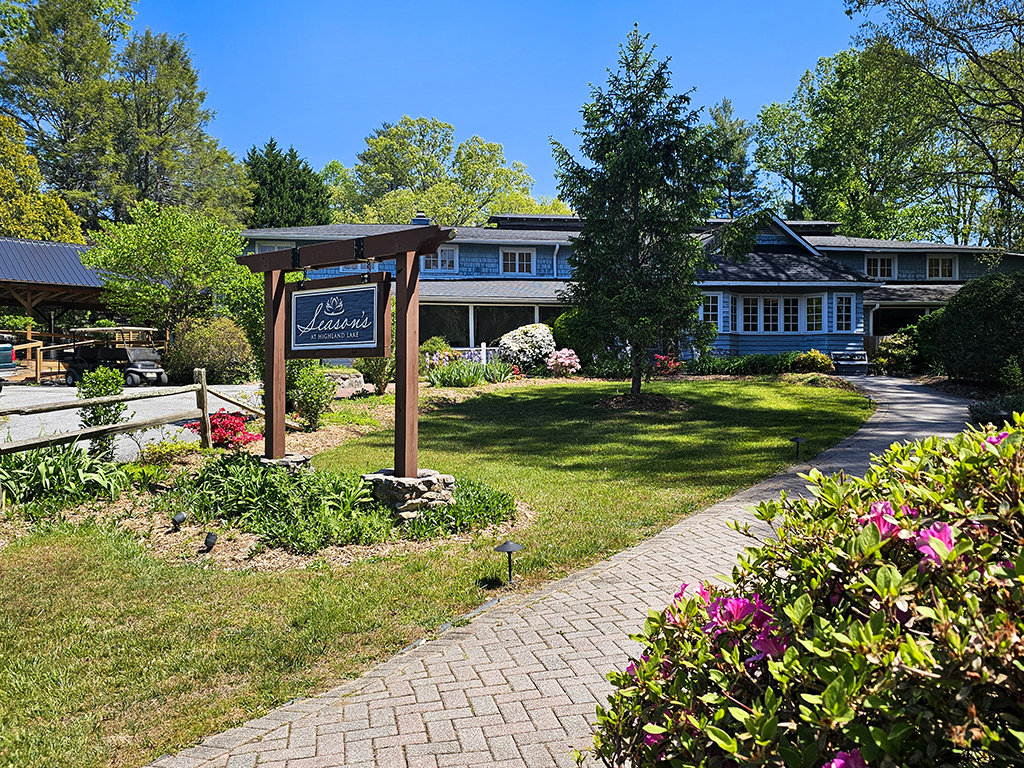
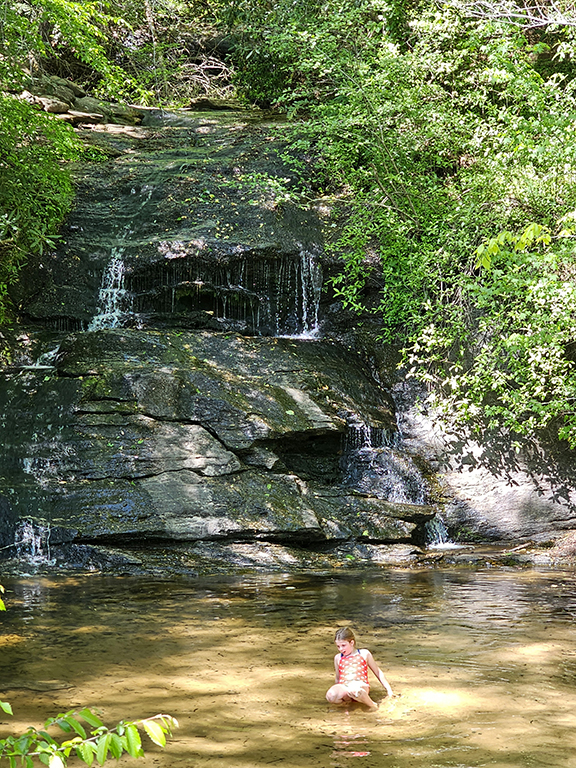
After an enjoyable meal and time to reminisce, we drove out to visit two waterfalls. The first, Wildcat Wayside Falls, was so close to the road that we didn’t even have to try to climb down the path for a view. It was a pretty spot, with a shallow pool below the falls. A family was enjoying the water, several girls were playing and splashing. One might be tempted to wonder why, on a weekday, they were not in school.
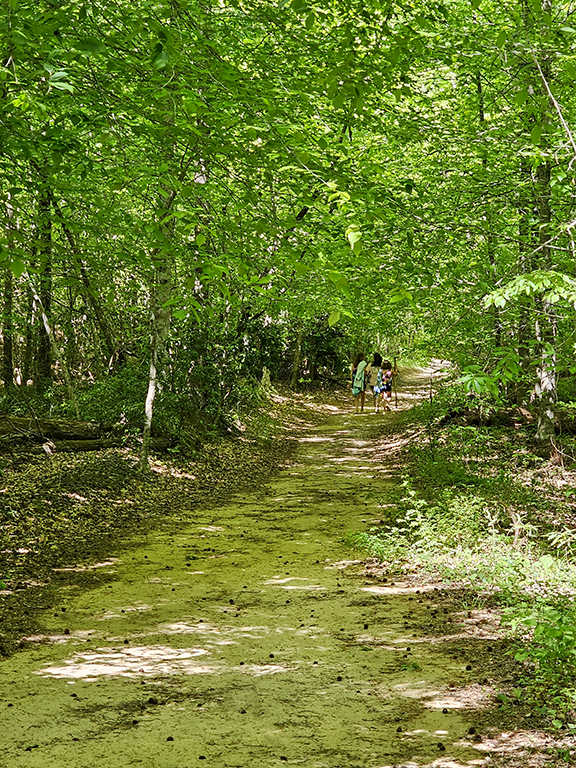
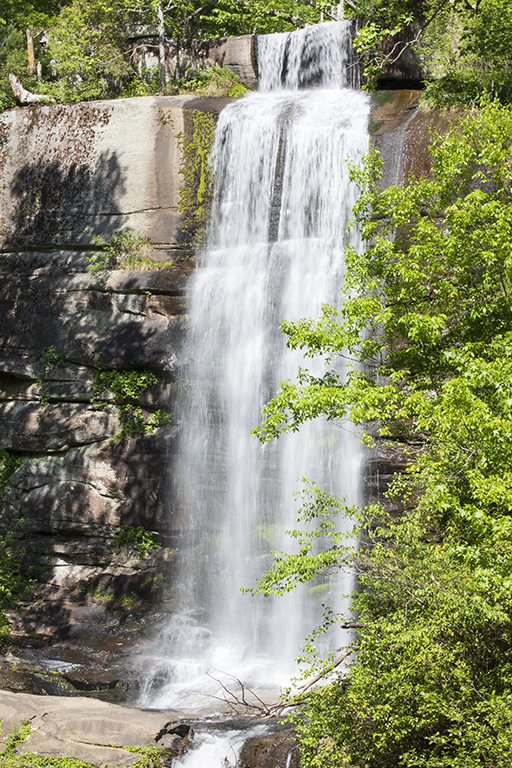
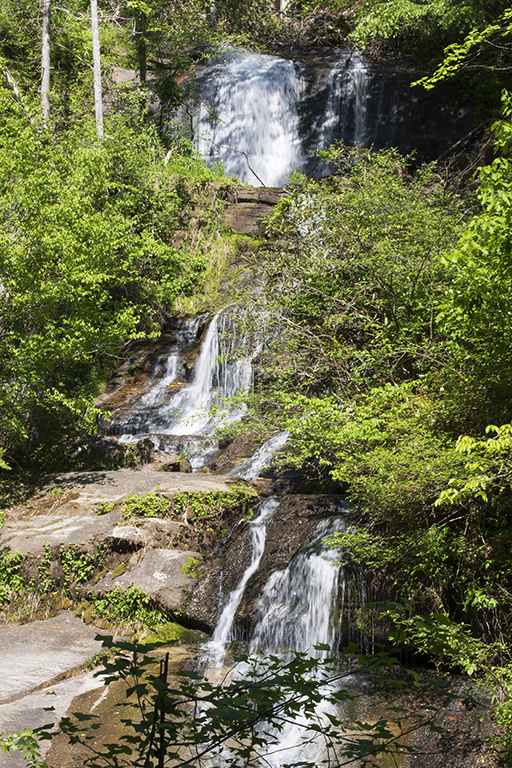
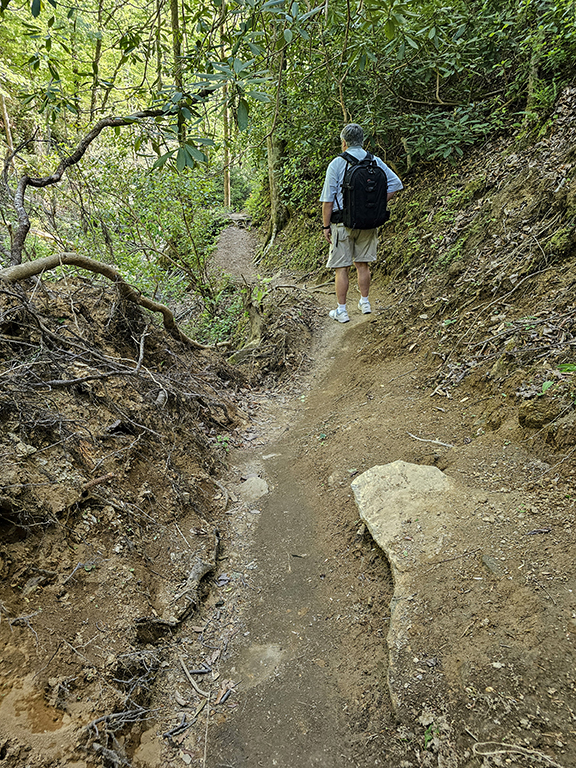
Twin Falls was a little more challenging. After a drive along increasingly narrow and winding roads, we found the car park and set off for the ¼ mile hike. At first the path was wide, flat, and a nice mix of sand and gravel, but that was what my mother would call “a snare and a delusion”. The path began climbing and was narrow and twisty with lots of roots and rocks for tripping over. After about 5 miles of tricky walking in the heat (okay okay, it was ¼ mile), a lookout shelter appeared and the views were definitely worth the walk.
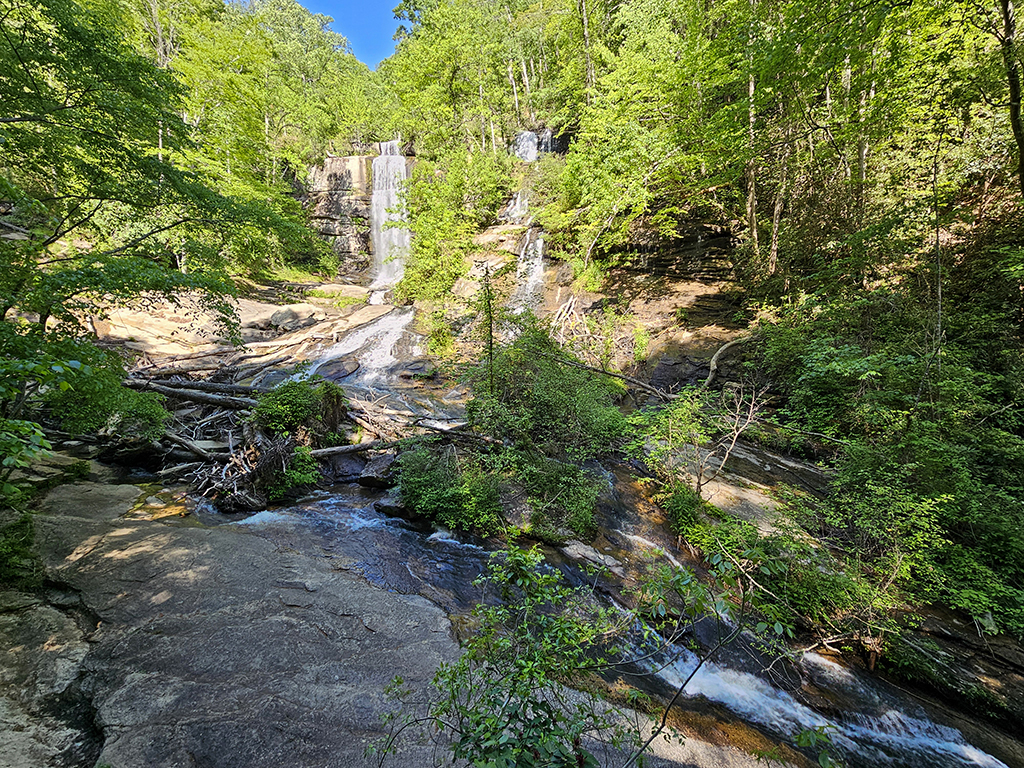
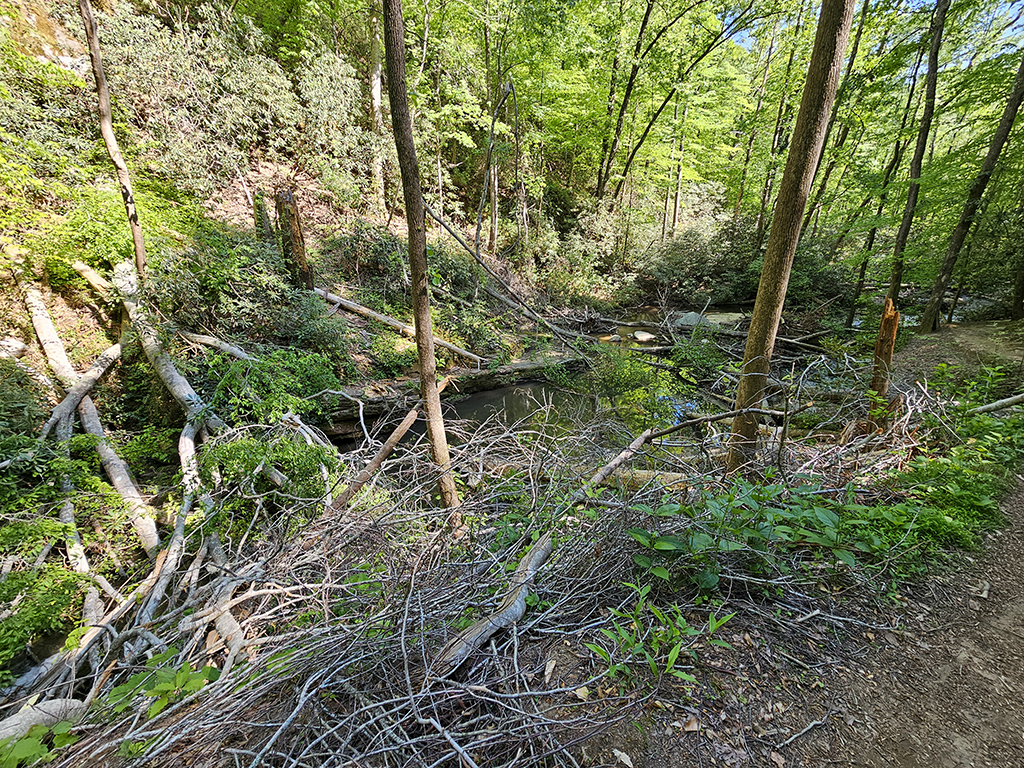
Multiple cascades step down from granite shelves. The tallest waterfall drops 75 feet to the river, but the one to the side (the twin) is equally beautiful if somewhat more subtle. Along the path as we returned to the car, we could see the evidence of the devastation from Hurricane Helene in September 2024. Downed trees and debris still cover much of the river, and parts of the footpath are washed out.
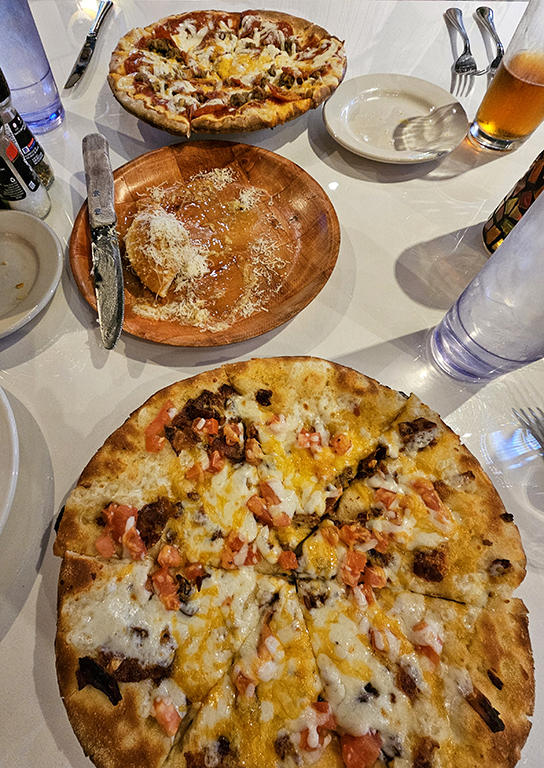
After returning to Greenville and a pause for a rest (nap), we looked in at the bar downstairs in the hotel, but it was full of very noisy men who were attending a conference. We walked a few blocks to a highly rated casual Italian restaurant and had pizzas. They had a very tasty crust, but were clearly made up ahead of time, as there were no choices of toppings other than their standard offerings (some of which were quite innovative). Returning to the hotel, the bar was much quieter, so we enjoyed a nightcap before returning to our room.
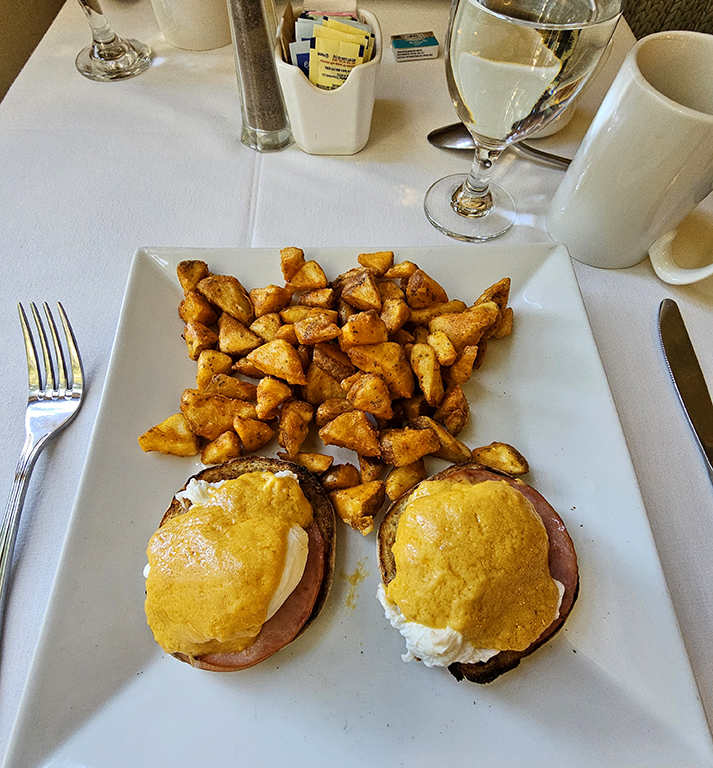
On Thursday morning we walked over to the Westin Hotel to have breakfast, as Spring Hill Suites doesn’t offer a “proper” restaurant breakfast. Dick ordered an omelette, and I tried their version of Eggs Benedict. The hollandaise was a very strange colour, but it tasted all right. It didn’t occur to me to ask for the eggs to be soft, but the whole thing tasted very nice. Their home fries were outstanding.
Dick went for a long walk in Falls Park, and then we met to take a look at a couple of shops that we had not had time for earlier. Dick found some golf shirts at Orbis.
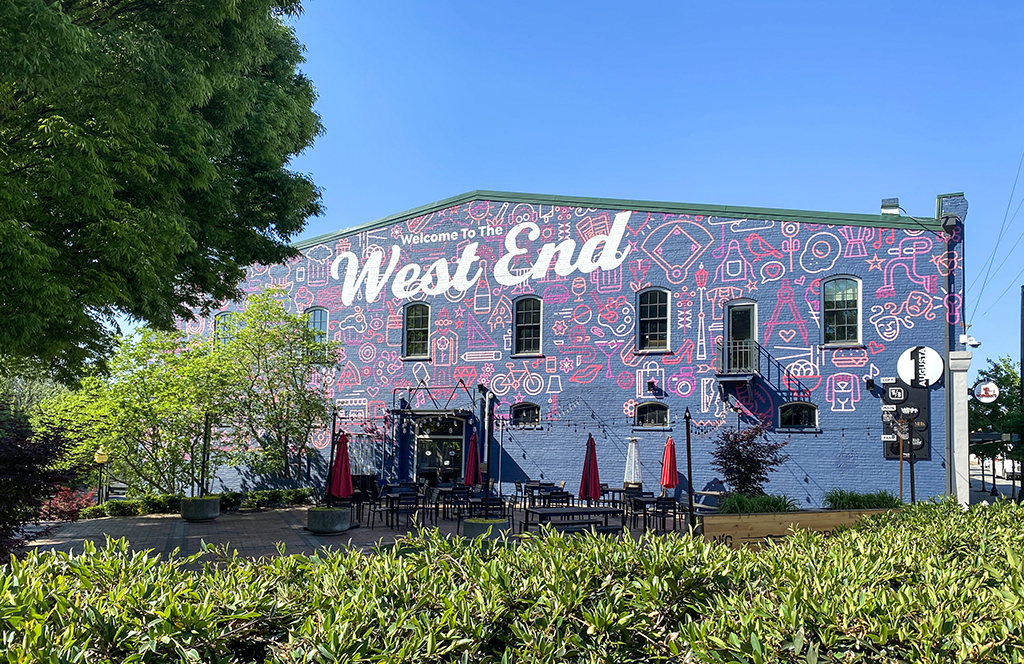
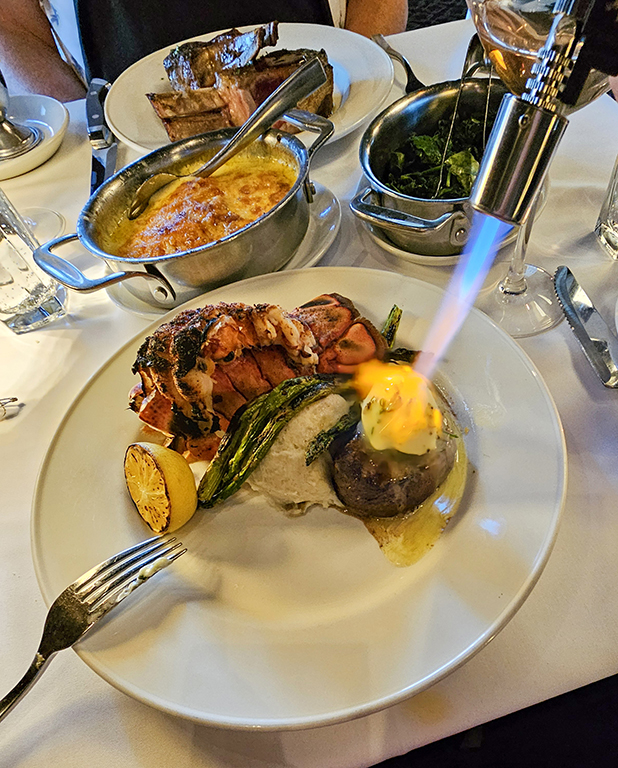
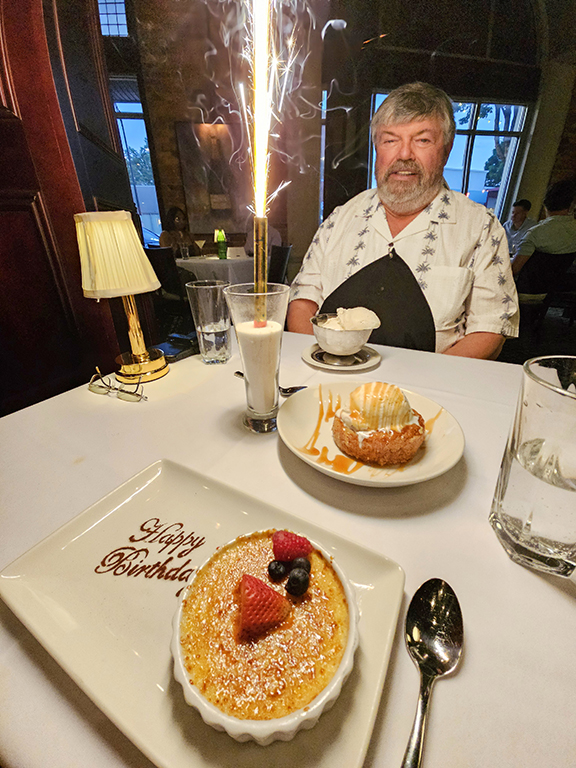
Dinner was at Rick Erwin’s West End Grille. Dick had told them that it was my birthday. The food was excellent, definitely the best meal we had in Greenville. After tasty starters, Dick ordered the veal chop, and I chose surf and turf. A 4-oz filet was accompanied by a grilled lobster tail. The truffle butter on the steak was melted at the table with a blowtorch, a bit of a surprise. The steak was perfectly cooked for my preference, and the lobster tail was tender and delicious. Desserts were also something of a surprise. The waiter mentioned crème brulee, but we ordered other choices, a single scoop of vanilla ice cream for Dick (he can be quite boring in his dessert choices) and something called “butter cake” for me, which the waiter waxed lyrical in his description. Sadly, it was not to my taste, far too sweet. Dick’s single scoop would have been enough ice cream for a family of four. The surprise was that the desserts, plus a (delicious) crème brulee, were brought to the table with a huge sparkler. It was an interesting, and very much appreciated way of marking the occasion. Far better than when the wait staff gather to sing a (usually) excruciating version of “happy birthday to you!” After sampling from three desserts, plus the excellent starters and main courses, we were both happy that we had chosen to drive to the restaurant and were not facing a long walk back to the hotel.
We enjoyed Greenville very much, and would certainly recommend it as a destination for a city break. Perhaps we will return one day and spend some time in the West End, which we didn’t have time to explore on this visit.


Leave a Reply